Covering large glazed areas: what works for wide windows and sliding doors
Why large glass panels need a different approach to blinds
Large windows, sliding patio doors and full-height glazing bring light and a sense of space into a room. But covering them well is not as straightforward as fitting a blind in a standard window recess. The sheer width and the way the glass moves (in the case of sliding doors) create practical problems that a simple off-the-shelf curtain track or a lightweight roller blind cannot solve. Understanding what makes a blind work on a big expanse of glazing helps you choose something that looks tidy, operates smoothly and lasts for years without sagging, jamming or looking makeshift.
The main challenges with wide glazing
A typical window recess gives a blind side channels to run in, a fixed top and a predictable depth. Large glazed areas rarely offer that. You might have a patio door that slides, a French door that opens inward, a bay window with angled walls, or a fixed glass panel that spans several metres. In each case the blind must clear the window handle, avoid catching on moving parts and stay straight across a width that puts strain on its mechanism. The weight of the fabric, the length of the drop and the exposure to direct sunlight all multiply with size. A flimsy system will bow, pull unevenly or fail within a season. That is where professional blind fitting becomes relevant: getting the measurements right and choosing the right hardware for the span makes the difference between a blind that works and one that frustrates.
What changes when the glass runs floor to ceiling
Full-height glazing adds another factor. The blind must be long enough to cover the whole drop, and the bottom rail needs enough weight to keep the fabric taut. Without that weight, the blind will billow in a draught or hang crookedly. At the same time, the top fixing must be secure enough to hold that extra weight without pulling away from the frame or the ceiling. Many standard brackets are designed for a typical window depth and a moderate load; on a tall run they can flex or work loose over time. Choosing a system with heavy-duty brackets and a reinforced bottom bar is a simple precaution that avoids problems later.
Options that suit large spans
Not every blind style works well at scale. Some are better suited to the job because of their mechanism, the way they tension the fabric and the support they get from their fixings. Below are the main types that handle wide glazing well, along with what to watch for with each.
Vertical blinds
Vertical blinds have a track mounted at the top, with individual louvres that hang down. They can be drawn to one side or tilted to control light. Because each louvre carries its own weight and the track distributes the load evenly, vertical blinds manage widths of three metres or more without sagging. They are also practical for sliding doors because the louvres can be drawn clear of the opening. The main downside is that the louvres can flutter in a strong breeze if the window is left open, and they need careful handling when cleaning. For a large sliding door in a living room or a conservatory, vertical blinds remain a popular and functional choice.
Roller blinds with side channels
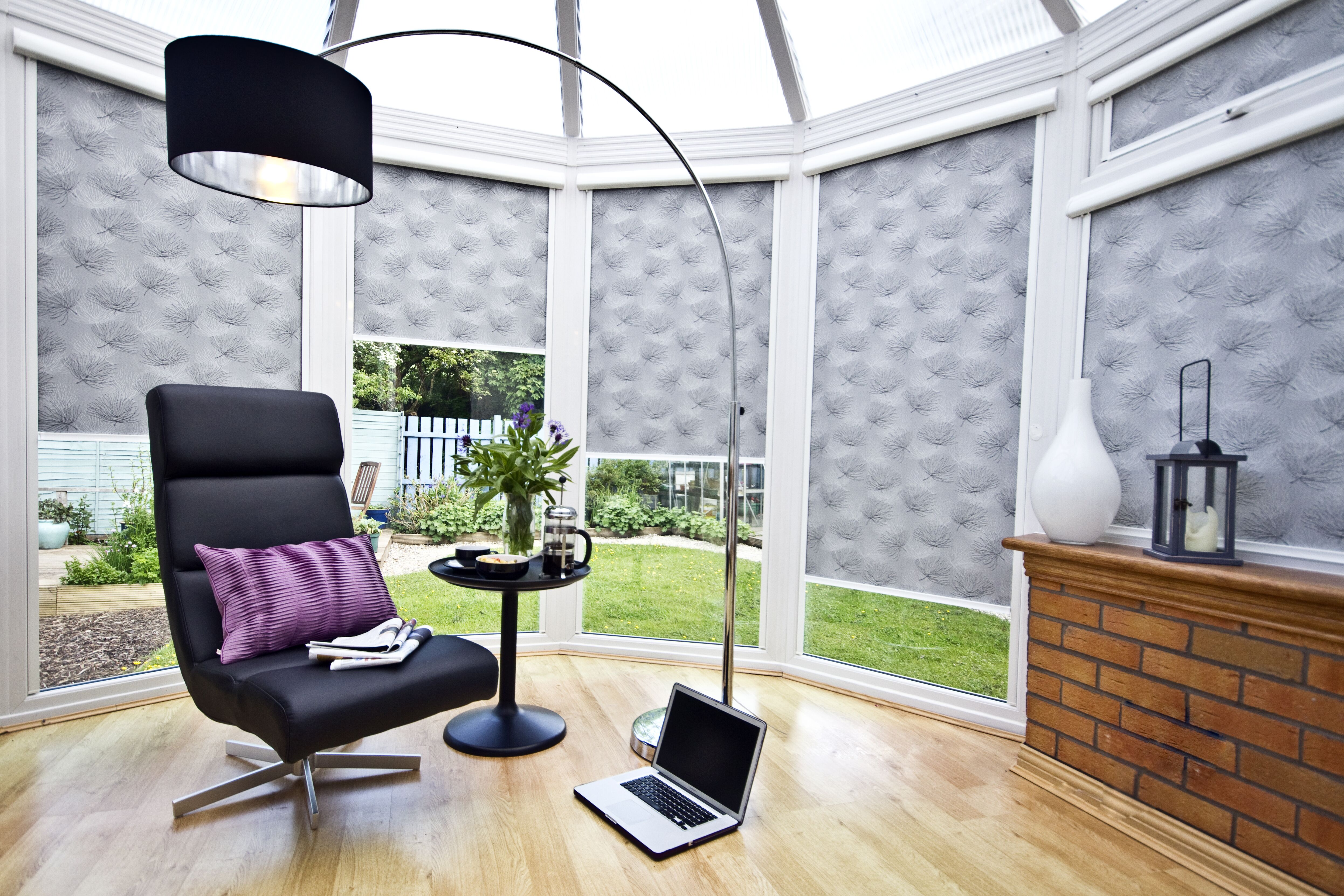
A standard roller blind on a wide window can bow in the middle because the fabric pulls the tube downward. A solution is to use a roller system with a spring-tension side channel or a weighted cord guide that keeps the fabric flat. Some systems also use a larger-diameter tube that resists bending. When the blind is fixed to the ceiling rather than the top of the window frame, the roller can sit flush and the blind can drop straight down without rubbing. This approach works well for large fixed windows or for a run of windows that look best covered as one continuous expanse.
Panel blinds
Panel blinds (sometimes called sliding panel blinds) use wide fabric panels that slide on a track, much like a sliding door. They are designed specifically for large openings and offer a clean, contemporary look. The panels stack neatly to one side when open, and they can be made in a variety of fabrics including blackout materials. Because each panel is supported by a top track and a bottom guide, the fabric stays flat even on wide spans. Panel blinds are a strong option for patio door blinds, especially when the door is used frequently, as the panels move smoothly and do not obstruct the handle or the frame.

What to check before buying
A few practical checks help you avoid the most common mistakes when covering a large glazed area.
- Measure the exact width and drop at several points. Walls and frames are rarely perfectly square. Take the width at the top, middle and bottom, and the drop on both sides. Use the smallest width for a recess fit, or add overlap for an outside fit.
- Check the handle clearance. On a sliding or French door, the blind must sit far enough forward or be short enough to clear the handle when the door moves. A blind that catches on the handle every time you open the door will quickly get damaged.
- Consider the fixing surface. Is the top fixing going into timber, uPVC, aluminium or plasterboard? Each material needs a different screw and plug. For a heavy blind on a wide span, the fixing must be solid. If the frame is uPVC, use screws that bite into the metal reinforcement inside the profile.
- Think about how the blind will be operated. A very wide blind can be hard to reach from one side. A cord or chain that is too long can tangle, and a motorised option removes the need to pull on a long cord. For a window that is opened and closed often, motorisation can also mean less wear on the mechanism.
When a recess fit is not possible
Not every large window has a deep enough recess to hold a blind inside the frame. In those cases the blind must be mounted on the face of the wall or on the ceiling. A face-fit blind sits outside the frame and overlaps the glass, so it blocks light more completely but also protrudes into the room. A ceiling fit keeps the blind flush with the ceiling and can make the window look taller. Both methods require accurate measuring and secure fixing into the structure behind the plaster. For a bay window with angled walls, the blind may need to be cut to match the angles, or separate blinds can be fitted to each section. Professional blind fitting takes these variables into account and ensures the blind is mounted squarely and securely.
How the right choice affects the room
Beyond the practical side, the blind you choose changes how the room feels. A single continuous blind across a wide window makes the space look bigger and more orderly than several small blinds joined together. It also avoids light gaps at the joins. On the other hand, a single blind that is very wide can be awkward to handle when you need to clean it or take it down. Weighing these trade-offs helps you decide what suits your room and your daily routine. For many homes, patio door blinds in a panel or vertical style offer the best balance of appearance, ease of use and durability.
Working with unusual shapes
Angled walls, roof windows and irregular openings add another layer. A roof window, for example, needs a blind that can be fixed to the sloping frame and operated without the fabric sagging away from the glass. Some systems use tensioned side rails that hold the blind against the window even when it is tilted. For an angled wall, such as in a bay window where the sides are set at an angle, a standard track cannot simply be bent without losing smooth operation. Purpose-made corner connectors or separate blinds for each section are the reliable solution. In every case, the principle is the same: the blind must be securely fixed, properly tensioned and matched to the shape of the opening.
Making the investment last
Large blinds are not cheap, so it makes sense to choose a system that will hold up over time. Look for a track that is made from aluminium or reinforced plastic rather than a thin extruded profile. Check that the fabric has a coating that resists fading and that the seams (if any) are double-stitched. A cordless or motorised mechanism removes the parts that most often break on a standard blind: the cord, the chain and the pulley. If you are fitting blinds to a large area, paying a little more for a stronger track and a better fabric pays back in years of trouble-free use.